
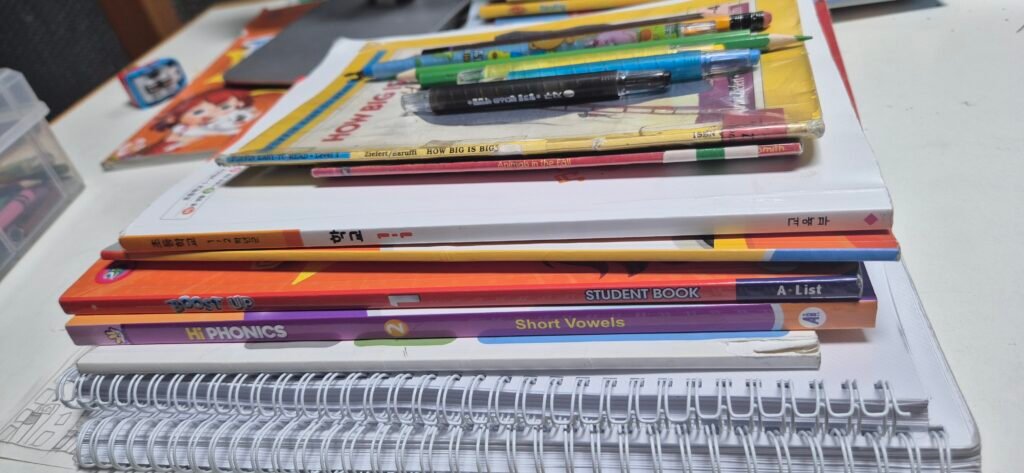
Introduction: Why is the World Watching Korean Elementary Education?
South Korea’s passion for education has evolved beyond simple academic desire into a massive social phenomenon. Recently, major global outlets like CNN and the BBC have highlighted the “Elementary Prep for Medical School” craze, leaving many international readers in shock.
I am a working mom (“K-Mam”, “K-Umma”) living in one of Gyeonggi-do’s representative *Hakgun-ji* (prestigious school districts). My son, who just turned 7, started first grade this year. Every morning, I prepare his clothes and breakfast before heading to work, while my husband—currently on a career break—sees him off to school.
Through my daily life of managing my son’s rigorous schedule after work, I want to share exactly what a 1st grader’s day looks like in these academic hotspots. This post serves as a real-world guide for international readers curious about “K-Education” and for parents feeling overwhelmed by the transition to elementary school.
1. The “Big Three” Holy Grails of Korean Education
In Korea, the term “Hakgun-ji” refers to more than just a neighborhood with schools. It signifies a high-density area of elite private academies (Hagwons) and parents with exceptionally high academic expectations.
*Daechi-dong, Gangnam (The Mecca of Private Education): This is the heart of Korea’s tutoring industry, home to the most famous instructors and vast amounts of exam data. At 10:00 PM—the legal curfew for academies—the streets turn into a massive parking lot. This is known as the “Riding War,” where hundreds of parents wait to pick up students ranging from 1st graders to high school seniors.
*Mok-dong (The Pride of Western Seoul): Competitive with Gangnam, Mok-dong is legendary for building “academic stamina” in children from elementary through middle school.
*Pyeongchon & Bundang (The Hubs of Gyeonggi Province):** I live in Pyeongchon, where the ‘Gwiin-dong Academy Street’ boasts the highest density of educational facilities in the southern metropolitan area. Alongside Bundang (near the “Silicon Valley” of Korea, Pangyo), these areas are now the epicenter of the “Medical School Prep Class” trend for elementary students.
2. Public Support vs. The “Picketing” Reality
Korean public schools offer several support systems for younger grades to help working parents:
* Care Class (Dolbom): Focuses on safe supervision and play, highly popular among dual-income families.
* Neulbom School: A new 2024 initiative providing 2 hours of free, play-based arts and physical education programs for 1st graders to bridge the “care gap” before parents finish work.
* After-school Programs: Affordable, high-quality classes like coding, robotics, drones, chess, and creative arts held within the school.
However, in ‘Hakgun-ji’ areas, signing up for these programs is called “Picketing” (a portmanteau of “Blood” and “Ticketing”) because it is so competitive. My son’s school didn’t start the first-come-first-served registration until two weeks after the semester began. For a working mom, the risk of failing to get a spot is too high—leaving a massive gap in the afternoon schedule. Consequently, many parents “swallow the bitter pill” and opt for private academies outside of school for more stability.
3. The “100-Minute Sprint”: A 1st Grader’s Afternoon
Once the school bell rings at 1:30 PM, the *real* day begins. The standard schedule for a 1st grader in a top district revolves around ‘English’ and ‘Critical Thinking Math.’
* Level 1: Elite English Academies: For many kids here who graduated from “English Kindergartens,” English isn’t just a subject; it’s about maintenance. They attend classes 5 days a week, staying for **100 minutes** (one hour and 40 minutes) per session to debate with native speakers and write essays. While 100 minutes sounds grueling for a 7-year-old, it is considered the norm here.
* Level 2: Critical Thinking Math: The current buzzword in K-Education is “Literacy.” Even math problems now involve long, complex paragraphs that require logical reasoning. Students spend another 100 minutes twice a week at specialized math academies.
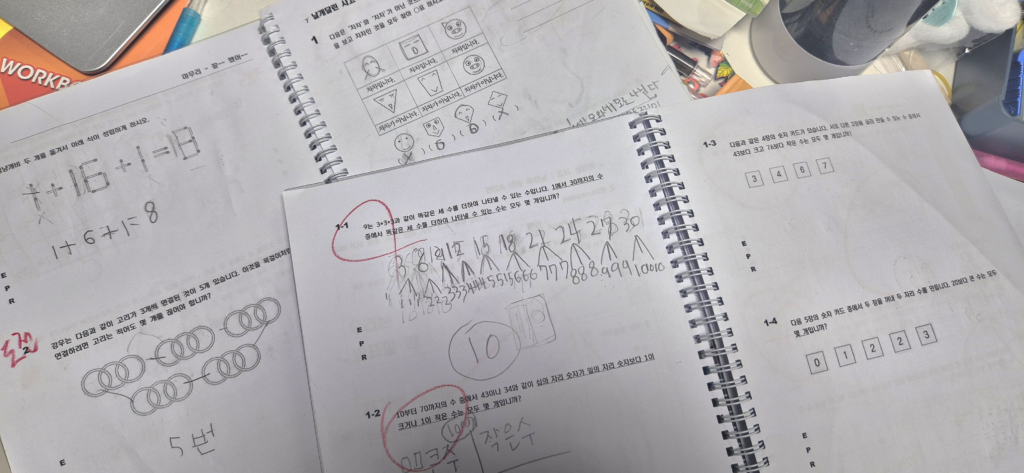
> **Mom’s Tip: On days when my son finishes 100 minutes of English and immediately heads into 100 minutes of Math, my heart aches seeing his small back as he enters the classroom—yet I feel an immense sense of pride in his resilience.
4. Finding Balance: The “Micro-Play” Strategy
You might wonder, “When do the children play?” The answer lies in “Micro-Play” (Tteum-sae time). On 4-period days, kids get about an hour at the playground; on 5-period days, it’s barely 20 minutes. These fleeting moments on the slides and swings are their “escape hatches” that help them endure the day.
Around 6:00 PM, when we return from work and my son finishes his second academy, our family time finally begins. After dinner, we spend 20 minutes checking his homework together. We spend the rest of the evening folding origami or playing board games to nurture his emotional well-being. Despite the heavy workload, maintaining a strong emotional bond with the child is the true “secret sauce” of parenting in these competitive districts.
Conclusion: The Love Behind the Pressure
Some critics view this system as “excessive competition.” However, being on the ground, I see that this intensity isn’t just about being “Number One.” It is a manifestation of a parent’s deepest love—a desperate effort to provide their child with the “weapons” and “armor” (skills and resilience) needed to navigate an ever-changing future.
A 1st grader’s day in a top school district is undeniably tough, but within it, children learn patience and the sweet taste of achievement. I hope this real-world look into the K-Education schedule provides valuable insight for those curious about our culture.